Two teenagers were arrested in Houston for a "grand scheme" involving pipe bombs and school shootings. The hosts question the logic of the plot and speculate on the potential role of SSRI medications in such incidents.
31 chapters across the catalog
Two teenagers were arrested in Houston for a "grand scheme" involving pipe bombs and school shootings. The hosts question the logic of the plot and speculate on the potential role of SSRI medications in such incidents.

Chevron Deference, Gorsuch and the Administrative State
The Supreme Court is poised to reconsider "Chevron deference," a 40-year-old precedent that allows federal agencies to interpret ambiguous laws. Justice Neil Gorsuch is highlighted for his skepticism of the doctrine, arguing it conflicts with the Administrative Procedure Act. The hosts explain that overturning Chevron would shift power from unelected bureaucrats in the "administrative state" back to the legislative branch, potentially impacting regulations on everything from electric cars to drug approvals.
A Long Branch, New Jersey firefighter named David Phillips saved a "lifeless" baby handed to him by a family who did not speak English. Phillips performed back blows to clear the infant's airway, successfully restoring the child's breathing. The segment concludes with a story about a four-year-old girl who climbed 30 feet up a tree and required a cherry picker rescue.
Media outlets like MSNBC and reporters such as Chuck Todd drew parallels between Donald Trump's campaign rally in Waco, Texas, and the 30th anniversary of the Branch Davidian standoff. Critics suggested the location was a deliberate choice to signal a "standoff" against federal agents. The hosts argue the media is intentionally creating a narrative of extremism to frame Trump's legal challenges.

Congressional Subpoena Power, Power of the Purse
Jeffrey Clark emphasizes that the House must use its "power of the purse" to compel the executive branch to release documents. He notes that if the administration refuses to cooperate with the weaponization subcommittee, the situation could ripen into impeachment proceedings.

Kara Swisher Interview, CIA Technologist Dawn Meyericks
Journalist Kara Swisher interviews Dawn Meyericks, the CIA's Deputy Director for Science and Technology, on her podcast "Sway." The hosts critique Swisher's fawning interview style and her repeated jokes about wanting to be recruited by the agency. Meyericks discusses the challenges of maintaining "digital dust" and undercover identities in the age of facial recognition.
Republicans and Democrats are weighing the electoral consequences of a rapid Supreme Court confirmation. While some believe it will depress Democrat turnout, others fear it will energize the opposition. Amy Coney Barrett is identified as a frontrunner for the nomination due to her age and conservative credentials, though the hosts note that justices often change their leanings once seated.

Department of Justice, Presidential Intervention Authority
A discussion regarding the President's constitutional authority over the Department of Justice featured a clip of a legal expert with a notably high-pitched voice. The segment explored the norms of prosecutorial independence versus the President's legal standing as the head of the executive branch.
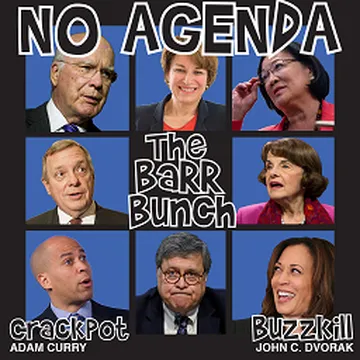
Attorney General William Barr, Resistance Strategy Speech
Attorney General William Barr delivered a speech to the Federalist Society criticizing the "resistance" movement against the Trump administration. Barr argued that opponents have used every available maneuver to sabotage the executive branch, effectively shredding political norms. He characterized the current political climate as a "scorched earth" war against the administration's legitimacy.
Chris Cuomo, Michael Mukasey Branch of Government Debate
CNN host Chris Cuomo engaged in a heated debate with former Attorney General Michael Mukasey regarding the independence of the Special Counsel. Cuomo suggested the Special Counsel functioned as a separate mechanism from the Department of Justice, while Mukasey corrected him, noting it remains within the Executive Branch. The segment also references Cuomo's past controversial claim that it is illegal for the public to read WikiLeaks documents.
Executive Power, Attorney General, Separation of Powers
The constitutional relationship between the Attorney General and Congress is examined, emphasizing that the AG is part of the Executive branch and not managed by the Legislative branch. The pressure from Congress for the full Mueller report is described as a violation of the separation of powers, as the AG is not legally obligated to follow Congressional demands regarding internal Department of Justice work product.

Alexandria Ocasio-Cortez Civics Lesson, Three Branches of Government
Alexandria Ocasio-Cortez (AOC) was recorded mistakenly referring to the "three chambers of Congress" and the "three chambers of government," including the Presidency, Senate, and House. The hosts deconstruct her error, noting she omitted the Judicial branch entirely. Despite these gaffes, they discuss her rising celebrity status and potential future in the Democratic Party.
The origins of the Supreme Court's power and the concept of judicial review are explored in the context of the upcoming confirmation battle. While Congress makes the laws, the judiciary determines if they meet constitutional requirements. A "constitutional crisis" would occur only if the executive or legislative branches refused to recognize a court's ruling, though in practice, unconstitutional laws simply become unenforceable by police and lower courts.
The hosts conclude the episode by teasing a deconstruction of the upcoming OIG report and Rudy Giuliani's comments on presidential pardons. The show ends with a montage of classic "No Agenda" soundbites, including "Stop the Hammering" and a final repetition of the word "denuclearizing."
President Trump directed the Pentagon to establish a "Space Force" as the sixth branch of the U.S. Armed Forces. While the move is presented as a way to ensure American dominance in orbit, it has sparked speculation regarding secret space programs and potential interdimensional threats. The announcement aligns with language previously found in the National Defense Authorization Act regarding "off-world" defense.

Senior Executive Service, Civil Service Reform Act of 1978
The Senior Executive Service (SES) was established in 1979 following the Civil Service Reform Act of 1978 to provide a stable layer of professional management within the US government. Created to prevent leadership vacuums during transitions, the SES allows for continuity when cabinet members are fired or resign. Historical context is provided regarding Jimmy Carter's 1979 "Cabinet Purge," which was made possible by the newly implemented SES structure.

Operation Olive Branch, Turkey Attacks Syrian Kurds
Turkey launched "Operation Olive Branch," a military offensive targeting Kurdish YPG forces in the Afrin region of Syria. The operation uses Turkish F-16s and ground rebels to oust groups that Turkey considers terrorists, despite those groups being U.S. allies in the fight against ISIS.
Professor Stephen Cohen discusses the concept of a "fourth branch of government" consisting of intelligence services that thwart presidential foreign policy. Cohen argues that efforts by both Obama and Trump to cooperate with Russia against terrorism were sabotaged by the Department of Defense. The discussion posits that leaks are used as a tool to prevent any rapprochement between Washington and Moscow.
Senator Rand Paul expressed excitement about the first week of the new Congress, planning to repeal numerous executive regulations he deems unconstitutional. Paul argued that the Obama administration's "extremist academics" have stifled business and that Trump will sign these repeals to boost the economy.
During his filibuster of the Patriot Act, Rand Paul delivered a lecture on the collapse of the separation of powers and the rise of an unelected bureaucracy. He cited a GAO report regarding the massive economic cost of federal regulations that bypass congressional approval. Despite the speech, the hosts express skepticism toward Paul due to his support for the USA Freedom Act, which they argue merely moves bulk data collection to private telecommunications companies.