Topic: Funding

432 chapters across the catalog

Trust The Plan
Episode 1900 41:29 - 44:51

1900: Trust The Plan

European Financial Crisis, German Pension Funds, Digital Euro

Financial analyst Tom Luongo suggests that European leaders are seeking a war to manage a looming crisis involving German pension funds and tightening bond spreads. European Commission President Ursula von der Leyen has proposed mobilizing private savings into euro bonds to address the lack of a financial union. The situation is framed as a "financial war" between the US dollar and the Euro.


En Banc
Episode 1893 1:16:51 - 1:18:27

1893: En Banc

Mike Rowe, Gen Z Screen Time Statistics

Television host Mike Rowe critiques Generation Z for a lack of community involvement and excessive screen time. He cites statistics showing the average young person spends over 2,000 hours a year on digital devices. Rowe argues that this demographic is failing to volunteer for traditional civic organizations like the Lions Club or Boy Scouts.

Kill Switch
Episode 1892 26:43 - 28:02

1892: Kill Switch

Tarbell Fellowship and AI Reporting Influence

The Tarbell Fellowship is identified as an initiative that pays journalists to cover stories specifically about artificial intelligence. Concerns are raised that this third-party funding influences reporting in major outlets like The New York Times and CNN. The hosts suggest this creates a bias similar to pharmaceutical influence in medical reporting.

Kill Switch
Episode 1892 1:30:55 - 1:32:59

1892: Kill Switch

The Collapse of Situational Awareness Hedge Fund

A 24-year-old former OpenAI employee's hedge fund, "Situational Awareness," reportedly collapsed after growing from $3 billion to $45 billion in assets. The fund suffered massive losses due to high leverage and a failed bet against traditional software firms. Citadel eventually purchased the fund's public equities portfolio, narrowly averting a larger financial crisis for its lenders.

Flock Off!
Episode 1890 40:00 - 46:17

1890: Flock Off!

Wuhan Lab Funding and Reputation Management

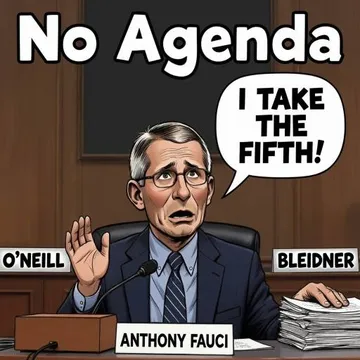
The hosts revisit the controversy surrounding NIH funding for the Wuhan Institute of Virology and Anthony Fauci's initial denials of such support. They discuss Rand Paul's assertion that Fauci could have avoided scrutiny by admitting early mistakes regarding "gain of function" research. The segment concludes that the current political proceedings are primarily aimed at dismantling Fauci's public legacy.

Dream Build Loop
Episode 1878 1:46:18 - 1:51:38

1878: Dream Build Loop

Bernie Sanders Proposes 50% Tax on AI Companies

Senator Bernie Sanders has introduced a plan to impose a one-time 50% tax on the stock of major AI companies to create a $7 trillion sovereign wealth fund. The fund would provide a $1,000 annual dividend to every American citizen and fund universal healthcare, addressing fears of mass unemployment caused by automation.

Screwball
Episode 1876 39:12 - 41:24

1876: Screwball

US Government Sovereign Wealth Fund Stake in OpenAI

The Trump administration and OpenAI CEO Sam Altman are reportedly discussing a plan for the U.S. government to take an equity stake in the AI giant. Senator Bernie Sanders has proposed a 50% government stake to ensure Americans participate in the financial upside of AI technology, mirroring sovereign wealth fund models used in the UAE and Abu Dhabi.

Screwball
Episode 1876 1:57:12 - 1:58:53

1876: Screwball

Nick Reiner Trust Fund Legal Battle

Nick Reiner, the 32-year-old son of director Rob Reiner, is petitioning a judge to release $1.5 million from his trust fund to pay for his legal defense. Reiner is accused of killing his parents and currently relies on a public defender after high-profile attorney Alan Jackson withdrew from the case due to payment issues.

Sonic Thump
Episode 1875 1:12:43 - 1:16:11

1875: Sonic Thump

Tech IPO Index Inclusion and Market Manipulation

New rules for the NASDAQ and New York Stock Exchange allow companies to be included in index funds just two weeks after their IPO, down from the previous three-month waiting period. This change forces passive index funds to buy shares during initial volatility, a move described as a "scam" that artificially props up the stock prices of companies like SpaceX or OpenAI.

Kennel Index
Episode 1874 1:01:40 - 1:08:10

1874: Kennel Index

Tara Palmieri, Yale Research, and the "Vessel" of Journalism

Tara Palmieri and Anderson Cooper discuss the psychological implications of Trump's "smile" comments, citing Yale professor Marianne LaFrance’s research on facial expressions. The discussion takes a bizarre turn as Palmieri refers to Collins as a "vessel" for the American people. The hosts mock the idea that Trump is trying to return to a 1950s archetype where women were only valued for their beauty and deference.

Supercycle
Episode 1873 1:51:52 - 1:54:08

1873: Supercycle

Gender Expansive Youth Funding and Alliance for Girls

The Alliance for Girls reported a $113 million loss in funding for non-profits serving girls and "gender expansive" youth under the Trump administration. Executive Director Chantal Hildebrand described the situation as an existential crisis for vulnerable communities. The hosts express confusion over the term "gender expansive" and question the nature of the government funding being cut.

VBS
Episode 1870 2:00:34 - 2:09:18

1870: VBS

J6 Anti-Weaponization Fund, IRS Settlement Details

Acting Attorney General Todd Blanche defended the creation of a $1.8 billion "anti-weaponization fund" intended to compensate individuals mistreated by the Biden Justice Department, including January 6 defendants. The fund was established as part of a settlement where Donald Trump dropped a $10 billion lawsuit against the IRS in exchange for a permanent ban on future audits of his family and businesses. While the administration frames it as reimbursement for legal fees, critics and some Republicans like John Thune have labeled it a "slush fund."

Spicy Mode
Episode 1833 26:32 - 30:04

1833: Spicy Mode

Citgo Acquisition, Paul Singer Hedge Fund Deal

Hedge fund manager and Trump donor Paul Singer completed an acquisition of Citgo Petroleum following a court-backed auction process. The US Treasury must still approve the deal, which aims to provide redress to creditors of the Venezuelan government while transferring refinery assets to American ownership.

Lincoln's Dome
Episode 1832 31:33 - 34:29

1832: Lincoln's Dome

Dr. Mehmet Oz, Medicaid Fraud Withholding in Minnesota

Dr. Mehmet Oz, representing CMS and HHS, announced the withholding of $1.3 billion in federal funds from Minnesota, California, and Illinois due to systemic Medicaid fraud. Oz criticized the Walz administration for failing to protect federal taxpayers from "Somali fraud" and insufficient corrective action plans. The federal government plans to audit Medicaid receipts and defer payments for 14 state programs identified as high-risk for abuse.

Lincoln's Dome
Episode 1832 2:05:57 - 2:09:11

1832: Lincoln's Dome

CPB Dissolution, NPR and PBS Funding Cuts

The Corporation for Public Broadcasting (CPB) has voted to dissolve after 58 years of service following significant federal and state funding cuts. Local affiliates, such as WNIN in Evansville, are transitioning to new business models that may include dynamically inserted advertisements and corporate sponsorships. Critics of public broadcasting argue that taxpayer support for these entities has long been unnecessary and ideologically biased.

Bulb Heads
Episode 1830 1:53:29 - 1:59:28

1830: Bulb Heads

Massachusetts Migrant Shelter Costs, Uber and Amazon Spending

A former migrant shelter director in Massachusetts revealed that the state is spending over $100,000 per month on Uber and Lyft rides for residents. Additionally, tens of thousands of dollars in Amazon deliveries for diapers, strollers, and electronics are processed daily at taxpayer expense. Many residents reportedly arrived from Chile and Brazil rather than directly from Haiti, citing Joe Biden's policies as the primary incentive for relocation.

Boomer Knowledge
Episode 1816 1:48:18 - 1:52:57

1816: Boomer Knowledge

Government Funding Bill and Senatorial Payout Clause

Representative Austin Smith of Georgia highlighted a controversial clause in a recent government funding bill that allows Senators to sue for $500,000 in damages if their phone records were subpoenaed during the January 6th investigation. The legislation creates a private cause of action specifically for lawmakers, which critics describe as a taxpayer-funded payout. The provision has drawn ire from House members whose records were also seized but were excluded from the compensation.

Hamburger Wine
Episode 1805 10:54 - 14:12

1805: Hamburger Wine

Senate Funding Impasse, John Thune, and NPR Funding

NPR reports on the Senate's failure to advance competing plans to end the government shutdown, with Republicans proposing funding through November 21st and Democrats seeking an October extension. Senate Majority Leader John Thune indicates that COVID-era healthcare tax credits remain a major sticking point. The hosts criticize NPR for failing to disclose that their own federal funding is a subject of the budget negotiations.

Hamburger Wine
Episode 1805 14:12 - 17:43

1805: Hamburger Wine

Targeted Spending Cuts, Bernie Sanders, and Shutdown Loopholes

The administration is accused of targeting spending cuts in areas with high Democratic voter concentrations, such as transportation projects in New York. Senator Bernie Sanders labels these tactics unconstitutional and illegal, while the White House blames Chuck Schumer for the halted projects. An anecdote is shared regarding how some national parks remain accessible during the shutdown via gate codes obtained prior to the closure.

Meloni in the Middle
Episode 1792 1:22:55 - 1:27:35

1792: Meloni in the Middle

Scott Bessent, Sovereign Wealth Funds, US Manufacturing

Treasury Secretary Scott Bessent is reportedly orchestrating a plan where foreign countries like Japan and South Korea provide the U.S. with a "sovereign wealth fund" through directed investments. These funds, totaling hundreds of billions, would be used to reshore critical industries and build new factories at the President's discretion. This strategy aims to de-risk the U.S. economy following supply chain vulnerabilities exposed during COVID-19.