Scott Adams acknowledges the talent of Rachel Maddow while disagreeing with her political perspective. He characterizes MSNBC as an "exaggerated version" of CNN, suggesting the network pushes biased opinions to an extreme level.
44 chapters across the catalog
Scott Adams acknowledges the talent of Rachel Maddow while disagreeing with her political perspective. He characterizes MSNBC as an "exaggerated version" of CNN, suggesting the network pushes biased opinions to an extreme level.

Media Mediocrity, The Crown and Law & Order Marathons
The hosts discuss the current state of "mediocre" entertainment, noting that there is very little high-quality content available. They mention personal viewing habits, including finishing "The Crown" and a family member's desperate marathon of 27 seasons of "Law & Order."

No Agenda Value-for-Value, D-Day Coordination Joke
The hosts discuss the logistics of recording the Christmas special and the "value-for-value" model that supports the show. They joke that their inability to coordinate simple tasks means they should never be in charge of military operations like D-Day. They encourage listeners to support the show through "time, talent, and treasure" at their donation website.
The hosts reflect on the four-year journey it took for the podcast to become a full-time endeavor after moving to Texas in 2011. The "Value for Value" system relies on "Time, Talent, and Treasure," where listeners contribute through financial donations, volunteer work, and technical expertise. This model avoids the "guilt-based" advertising of traditional media and fosters a community of producers who sustain the show's independence.
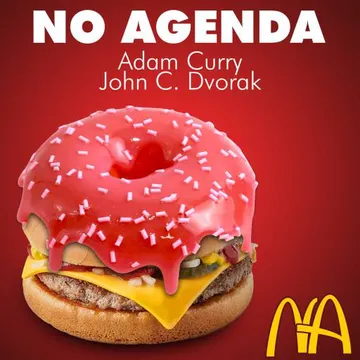
The hosts review recent listener-submitted artwork, selecting a "meta-cheesecake" piece by Francisco Scaramanga for the episode cover. They discuss the "three Ts" (time, talent, and treasure) and announce the criteria for becoming an Associate Executive Producer or Executive Producer.

Value for Value Model and Podcast Monetization
The hosts discuss the "Value for Value" model, noting its adoption by artists at a recent Bitcoin conference. The model encourages listeners to return value—via time, talent, or treasure—based on the value they receive from the content. This approach is presented as a superior alternative to traditional advertising for independent media.
The hosts explain the "Value for Value" model, encouraging listeners to return value through time, talent, or treasure. They promote the use of modern podcast apps from podcastapps.com that support live alerts, chapters, and streaming micropayments via Bitcoin. The segment emphasizes the importance of independent infrastructure to keep the show on the air without traditional advertising.
Sam Tripoli and his co-host on the "Tinfoil Hat" podcast are featured explaining the "Value for Value" model to their audience. They credit Adam Curry and John C. Dvorak for conceptualizing the system, which relies on "Time, Talent, and Treasure" instead of traditional advertising. The hosts express satisfaction that their model is being adopted by other independent creators to ensure self-sufficiency and avoid deplatforming.
Jesse Watters reports on the Ronna McDaniel firing, noting that she learned of her termination through the media and was subsequently dropped by her agency, CAA. The discussion explores the unchecked power of talent agencies in the news industry, referencing historical movements like "Time's Up" and the influence of agents on journalist assignments.

Twitter Spaces and the Value for Value Feedback Loop
A host describes a recent appearance on Twitter Spaces to explain the Value for Value model. The discussion emphasizes that the show relies on "time, talent, or treasure," noting that the community's contributions, such as website development, save the show millions in traditional operating costs.
The hosts thank the "No Agenda Nation" for their contributions of time, talent, and treasure, noting the show went full-time around episode 100. They review the artwork for episode 1599 by Matt Boisvert, titled "Drop The Op," which features a subtle misspelling of "Hamas" as "Hammas." This leads to a tangent about the quality of hand-ground hummus in the Middle East.
The program acknowledges several "value for value" donations, including a monthly commitment from a teacher for the deaf and a contribution from local Fredericksburg radio host Matt Long. The hosts emphasize that the show relies entirely on listener support in the form of "time, talent, or treasure." They encourage listeners to sign up for the newsletter to stay informed about upcoming episodes.

Talent Keyhole Intelligence, Catherine Herridge and Overhead Imagery
Catherine Herridge reports on the specific classified codings found in the Trump documents, specifically "TK" or "Talent Keyhole." This intelligence refers to high-resolution overhead imagery capable of identifying minute details on the ground. The hosts note the connection between the Keyhole technology and Google Maps, which originated from an In-Q-Tel-funded venture.
The hosts reiterate the "Value for Value" model, thanking producers for their "time, talent, and treasure." They encourage listeners to list their executive producer credits on professional platforms like IMDb and LinkedIn. The segment concludes with a final thank you to the donors who keep the show independent of corporate advertising.
The morning news cycle features a History Channel special on the 1921 Tulsa race massacre promoted by ABC and a CBS segment on stopping Asian hate. NBC focuses on entertainment with an interview featuring the hosts of America's Got Talent following its season finale. Ratings for the Billboard Music Awards reportedly fell to an all-time low of 0.7.
To stymie international criticism, the Hanban is rebranding as the "Ministry of Education Center for Language Exchange and Cooperation." Confucius Institutes are being spun off into a supposedly non-profit "Chinese International Education Foundation." Simultaneously, federal agencies are investigating dozens of researchers at NASA and the NIH for undisclosed participation in China's "Thousand Talents Plan."

Thousand Talents Program, Theft of Petroleum Trade Secrets
The FBI highlighted cases of economic espionage linked to China's "Thousand Talents" recruitment program, including scientist Hong Jintan, who stole $1 billion in trade secrets from an Oklahoma petroleum company. Another case involved the theft of naval technology used in submarines. Wray noted that Chinese state-owned enterprises often patent stolen American technology and then attempt to sell it back to the victimized companies.

Charles Lieber Indictment and Chinese Academic Espionage
Dr. Charles Lieber, the former chair of Harvard University's chemistry department, was indicted for making false statements regarding his involvement with China's Thousand Talents Program. The Department of Justice alleges Lieber received significant undisclosed funding from the Chinese government while also receiving U.S. federal grants. This case is described as the tip of the iceberg in a broader investigation into Chinese academic espionage and foreign influence in American universities.

Mike Pompeo Warns Governors About Chinese Influence
Secretary of State Mike Pompeo warns the National Governors Association to be wary of Chinese Communist Party (CCP) influence at the state and local levels. He references the arrest of Harvard professor Charles Lieber in connection with the "Thousand Talents Program" as evidence of academic infiltration. Pompeo claims the CCP maintains files on U.S. governors to determine who is amenable to Chinese business interests and the "Belt and Road" initiative.

Chinese Espionage in US Universities and Confucius Institutes
Attorney General Bill Barr and Secretary Mike Pompeo have highlighted the "Thousand Talents Plan," a Chinese program used to recruit U.S. scientists for intellectual property theft. The Department of Justice has indicted professors at Harvard and other universities, while many schools are closing "Confucius Institutes" due to their role as CCP propaganda and monitoring hubs.