Topic: Oxytocin

8 chapters across the catalog

Swagger
Episode 1033 2:33:40 - 2:49:52

1033: Swagger

Social Media Addiction, Face-to-Face Interaction Benefits

Psychologist Susan Pinker's research on longevity is discussed, highlighting that "social integration" and face-to-face contact are the strongest predictors of a long life. Physical interactions release oxytocin and dopamine, which lower stress and provide natural pain relief. A report on the Paradigm Malibu rehab facility for teens with social media addiction illustrates the mental health risks of replacing real-world bonds with digital ones.

Identitarian
Episode 956 2:14:35 - 2:16:31

956: Identitarian

Oxytocin Study and the "Cure" for Racism

Researchers at the University of Bonn conducted a study suggesting that enhancing oxytocin levels can make humans kinder to strangers. The story is analyzed as a potential precursor to pharmaceutical social engineering, where "racism" could be treated with a pill. The timing of the study's circulation in the media is questioned as possibly being part of a broader PR effort.

Roundly Debunked
Episode 932 1:22:59 - 1:24:37

932: Roundly Debunked

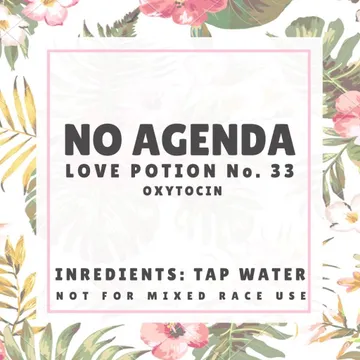
No Agenda Love Potion, Oxytocin, and Art Credits

The hosts discuss the latest show artwork by Melvin Gipstein, titled "No Agenda Love Potion Number 33," which features oxytocin. This artwork inspired a new jingle based on the classic "Love Potion No. 9." They encourage listeners to visit the No Agenda Art Generator to view and contribute artwork for the show.

Roundly Debunked
Episode 932 2:53:07 - 3:03:38

932: Roundly Debunked

Outro, Mastodon Trademark, and End of Show Mix

The show concludes with a discussion on the Mastodon social network project and the recent addition of a trademark to its name, which the hosts see as a sign of impending commercialization. They thank the "War Room" and the producers for their support. The episode ends with a long musical mix featuring show clips, Maxine Waters, and the "Love Potion" jingle.

Putin's Playbook
Episode 931 18:16 - 22:37

931: Putin's Playbook

Oxytocin Research, In-Group Bias and Xenophobia

Research conducted in the Netherlands explored the effects of oxytocin on social behavior and decision-making. While often called the "love drug," the study revealed that oxytocin increases cooperation with in-group members while simultaneously heightening xenophobia and aggression toward out-groups. Participants were less likely to sacrifice individuals with familiar names in "trolley problem" simulations when under the influence of the hormone.

Putin's Playbook
Episode 931 22:38 - 26:31

931: Putin's Playbook

Amazon Oxytocin Reviews, Placebo and Tap Water Claims

A review of oxytocin nasal sprays available on Amazon reveals skepticism regarding product authenticity. One reviewer, claiming to be a pharmaceutical researcher, stated that lab analysis showed the product was merely tap water. The hosts discuss the likelihood of these supplements acting as placebos and the ethics of selling such products online.

No-Stray Spray
Episode 461 2:31:38 - 2:36:09

461: No-Stray Spray

Oxytocin Research, Monogamy Hormone

Researchers have identified oxytocin as a "monogamy hormone" that may help men in committed relationships maintain distance from other attractive women. The hosts jokingly suggest it be marketed as "no stray spray" and discuss its potential as a nasal spray.

Kidnapping The Truth
Episode 195 1:53:04 - 1:59:49

195: Kidnapping The Truth

Low Testosterone, Low T Quiz, Oxytocin Study

A marketing campaign for "Low T" (low testosterone) is discussed, featuring the website isitlowt.com. The hosts take the online quiz and discuss the potential for a generation of "roided up" baby boomers, while also mentioning a study on how oxytocin injections make men more emotionally sensitive.