Topic: Regime Change

75 chapters across the catalog

CIS Lunar
Episode 1856 20:41 - 24:21

1856: CIS Lunar

Iran Regime Change Claims, Uranium Enrichment Stockpiles

President Trump claims that a "regime change" has effectively occurred in Iran due to the deaths of original leaders, though he maintains his primary goal remains the prevention of nuclear weapons. U.S. strategy involves striking Iranian bridges and infrastructure to force a deal while searching for 600 pounds of enriched uranium "dust." There is a stated intention to withdraw U.S. forces within weeks once specific military objectives are met.


Rackout
Episode 1854 26:37 - 30:14

1854: Rackout

U.S. and Israel Diplomatic Divergence, Energy Dominance Strategy

Reports suggest U.S. and Israeli war objectives are diverging as President Trump shifts toward negotiations while Israel remains committed to regime change in Iran. A geopolitical theory posits that the U.S. is pursuing complete energy dominance by controlling transit routes in Syria and the Strait of Hormuz. This strategy aims to force China and Europe to purchase American energy at retail prices in U.S. dollars.

Hose Water
Episode 1849 1:23:01 - 1:27:14

1849: Hose Water

Iran Leadership Vacuum, Assassinations and Potential Successors

President Trump discusses the military success in Iran but expresses concern over the lack of a viable successor, noting that many potential leaders have been killed. He mentions that the "radical lunatics" currently in power are being eliminated, but he is wary of a "worst-case scenario" where a new leader is equally hostile. The hosts discuss the tactical shift where Iranian leaders avoid technology following the "pager attacks," only to be targeted during in-person meetings.

Hose Water
Episode 1849 1:31:10 - 1:35:09

1849: Hose Water

Reza Pahlavi, The SAVAK and Regime Change

The White House and Secretary of War Pete Hegseth maintain that the conflict is not a "regime change war," despite questions about who will lead Iran. While some protesters call for the return of the exiled Crown Prince Reza Pahlavi, Trump has expressed skepticism about him. Mimi Smith-Dvorak provides historical context on the SAVAK (the Shah's secret police), noting that many of its members were integrated into the IRGC after the revolution.

Off-Ramp
Episode 1847 30:00 - 33:24

1847: Off-Ramp

Regime Change, Donald Trump's Strategy for Iran

The hosts critique media coverage regarding the potential for democracy to flourish in Iran. They examine Donald Trump's stated position of not seeking direct regime change, but rather weakening the current government to allow the Iranian people to act. The summary disputes the media's assumption that a secular transition automatically results in a democratic outcome.

Off-Ramp
Episode 1847 1:22:07 - 1:28:12

1847: Off-Ramp

Iranian Succession, The Crown Prince and Normalization

Lindsey Graham mentions discussions with the Iranian Crown Prince regarding a potential leadership transition, though the hosts question if this is official policy or Graham "freelancing." Graham also claims credit for normalization efforts between Saudi Arabia and Israel, confusingly mentioning Joe Biden's role. The segment highlights the confusion surrounding the U.S. plan for a post-Khamenei Iran.

Token Muncher
Episode 1843 2:20:45 - 2:24:05

1843: Token Muncher

Reza Pahlavi, Munich Iran Protests

Supporters of Reza Pahlavi, son of the former Shah of Iran, held a large rally in Munich during the security conference. Pahlavi called for a transition to a secular democratic future and requested support from foreign powers, specifically addressing Donald Trump. The hosts criticize the historical cycle of the U.S. installing and then attempting to restore the Pahlavi dynasty.

Greenland Gambit
Episode 1835 2:26:52 - 2:32:02

1835: Greenland Gambit

John Bolton and the Iranian Regime Change Gambit

Former National Security Advisor John Bolton appeared on MSNBC to advocate for US support of an Iranian regime overthrow, criticizing Donald Trump's restraint. Bolton argued for striking Revolutionary Guard headquarters and nuclear facilities to support internal opposition. Trump reportedly declined to meet with the self-proclaimed "crown prince" of Iran, viewing the push for war as a potential "gambit" to distract from other policy goals.

Swarm Forge
Episode 1834 1:19:08 - 1:24:35

1834: Swarm Forge

Mossad Allegations and the Iranian Diaspora

Iran's foreign minister claimed in a Fox News interview that recent violence was a Mossad operation designed to provoke US military intervention. Meanwhile, the Iranian diaspora remains fractured, with some supporting Reza Pahlavi, the son of the late Shah, who lives in exile in the US. Experts from Chatham House express doubt that the current opposition has the unity required to overthrow the Islamic Republic.

MUK-Ultra
Episode 1825 1:20:28 - 1:25:28

1825: MUK-Ultra

BBC Analysis, Trump Regime Change in Venezuela

The BBC analyzes Donald Trump's pressure campaign against Nicolas Maduro as a pursuit of regime change. Despite Trump's "America First" rhetoric regarding foreign wars, he appears to view Latin America as a "backyard" where the U.S. has a right to intervene. This policy is linked to a modern interpretation of the Monroe Doctrine and a desire to eliminate far-left influence in the Western Hemisphere.

Tomahawk Turnaround
Episode 1809 1:29:39 - 1:35:34

1809: Tomahawk Turnaround

Gen Z Protests in Peru, Madagascar, and Morocco

Anti-government protests led by Gen Z activists have erupted in Peru, Madagascar, and Morocco, leading to significant political shifts. In Peru, the removal of President Dina Boluarte followed deadly clashes, while in Madagascar, the UN condemned an unconstitutional change of government. Analysts suggest these movements may follow a specific "regime change" model, potentially influenced by external intelligence agencies or geopolitical interests related to the BRICS alliance.

Hamburger Wine
Episode 1805 54:40 - 59:15

1805: Hamburger Wine

Nicolas Maduro, Cocaine Trans-shipment, and Regime Change

The Trump administration offers a $50 million bounty for Venezuelan President Nicolas Maduro, accusing him of leading the "Cartel de los Soles." Expert Christopher Sabatini disputes the U.S. narrative, claiming Venezuela is merely a trans-shipment point for Colombian cocaine primarily bound for Europe. The hosts question Sabatini's specific knowledge of Venezuelan airspace and suggest the U.S. is using drug enforcement as a pretext for regime change.

Eat The Dog Food
Episode 1776 1:15:21 - 1:21:46

1776: Eat The Dog Food

Crown Prince Reza Pahlavi's Message to Iranians

Reza Pahlavi, the Crown Prince of Iran, issues a message from Washington D.C. calling for the removal of the "radical regime" in Tehran. He distinguishes the Iranian people from the Islamic Republic and offers to oversee a peaceful transition to democracy. The hosts reflect on the history of the 1979 revolution and express skepticism about further American meddling in Iranian internal affairs.

Boomer Benefits
Episode 1775 25:50 - 30:57

1775: Boomer Benefits

Trump Two-Week Deadline, China Geopolitical Strategy

President Donald Trump's repeated "two-week" deadline is identified as a strategic deception used to mask the timing of the Iran strike. The military buildup, including the movement of the USS Nimitz and F-22 squadrons, was completed in half the time typically expected by planners. The underlying motive for the strike is theorized to be a message to China and Pakistan rather than a simple nuclear disarmament mission.

Boomer Benefits
Episode 1775 45:16 - 47:01

1775: Boomer Benefits

Ayatollah Khamenei, Iranian Regime Theater Theory

A theory is proposed that the recent strikes and assassinations of Iranian officials might be a coordinated effort between the U.S., Israel, and the Ayatollah to purge hardline military elements. This "theater" would serve to rearrange Iranian power structures and remove Chinese influence from the region. The hosts suggest that the Iranian leadership and Western intelligence may be working toward shared goals behind the scenes.

Leave it to Bibi
Episode 1774 1:03:13 - 1:05:28

1774: Leave it to Bibi

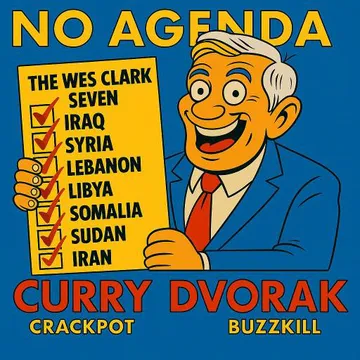
Wesley Clark's Seven Countries Memo, Middle East Regime Change

General Wesley Clark revealed in 2007 that the Pentagon had a plan to "take out" seven countries in five years, including Iraq, Syria, Lebanon, Libya, Somalia, Sudan, and Iran. This roadmap for regime change has largely been followed through various conflicts and proxy wars. The current focus on Iran is seen as the final stage of this decades-old military objective.

Pod Roll
Episode 1719 39:03 - 43:31

1719: Pod Roll

Tulsi Gabbard's Past Meeting with Bashar al-Assad

Tulsi Gabbard's 2017 meeting with Bashar al-Assad is resurfacing as she faces confirmation for Director of National Intelligence. While Gabbard defends the meeting as a diplomatic effort to end "regime change wars," critics like John Bolton argue her positions are on the "outermost fringe" of American politics.

Sloppin' Hopper
Episode 1702 2:05:22 - 2:08:36

1702: Sloppin' Hopper

General Wesley Clark, Iran Regime Change, World War III

Retired General Wesley Clark argues that Israel must "strike hard" at Iran, calling the country the source of regional instability. Clark advocates for regime change, stating that Iran's pursuit of nuclear weapons makes the current government intolerable. He dismisses concerns that striking Iranian oil fields would spark World War III, suggesting instead that it is a necessary move for regional dominance.

Turban Tossing
Episode 1700 2:12:33 - 2:13:49

1700: Turban Tossing

Benjamin Netanyahu, Iranian Regime Change Speech

Benjamin Netanyahu delivered a speech in English addressed directly to the people of Iran, calling for the removal of the "mullahs" and promising a future of peace and prosperity. The hosts interpret this as an attempt to trigger a new "color revolution" within Iran, similar to the 2009 Green Movement.

Honorifics
Episode 1597 31:18 - 38:32

1597: Honorifics

General Wesley Clark and the Seven Countries Strategy

A 2007 interview with General Wesley Clark is revisited, detailing a 2001 Pentagon memo that outlined plans to "take out" seven countries in five years, including Iraq, Syria, Lebanon, Libya, Somalia, Sudan, and Iran. The discussion links this historical strategy to current geopolitical maneuvers aimed at destabilizing the Middle East to counter Russian and Chinese influence. Claims are made that the ultimate target of the current escalation is Iran.