CNN receives rare access to a U-2 spy plane mission targeting ISIS. The report highlights technological upgrades to the 1950s-era aircraft. The hosts characterize the segment as a "sales job" for Lockheed Martin's military hardware.
8 chapters across the catalog
CNN receives rare access to a U-2 spy plane mission targeting ISIS. The report highlights technological upgrades to the 1950s-era aircraft. The hosts characterize the segment as a "sales job" for Lockheed Martin's military hardware.

US Drones in Nigeria and the Petroleum Corporation Scandal
The deployment of US Global Hawk drones to Nigeria is discussed in the context of the missing schoolgirls and broader regional corruption. Adam Curry links the international attention to a scandal involving $49.6 billion missing from the Nigerian National Petroleum Corporation. The segment also touches on the cultural naming conventions in Nigeria, including names like "Goodluck" and "Cell Phone."
Adam reports on the deployment of a US Global Hawk drone to Nigeria to search for the missing girls, expressing skepticism about the drone's true purpose. He also shares an email from a South African listener regarding unique naming customs in tribal cultures, where names like "Goodluck," "Beauty," and even "Cell Phone" are common.

Northrop Grumman, Global Hawk Comic Book and Drone Marketing
Northrop Grumman has released a comic book titled "Global Hawk: Endless Possibilities" to market its surveillance drones to children. The story depicts a father working on the Global Hawk program and highlights its use in disaster relief and border security. The hosts compare this to 1950s-era Disney and GE propaganda promoting nuclear power, noting the "bonanza" of the future drone industry.
An RQ-4 Global Hawk drone crashed in Maryland during what was described as a routine training flight after losing contact with ground operators. Concerns are raised regarding the Navy's operation of large-scale drones over domestic airspace. The technical challenges of remote operation, including signal lag and situational awareness, are highlighted as inherent risks in the drone program.
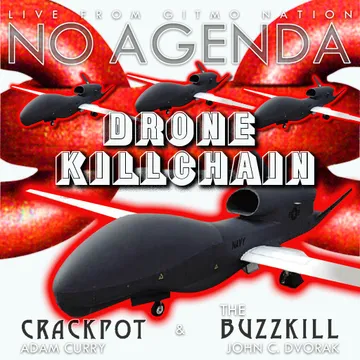
The Los Angeles Times reports that the U.S. military is increasingly reliant on civilian contractors within the "drone kill chain." Data suggests that operating a single Predator or Global Hawk drone requires significantly more personnel (up to 300 people for 24 hours) than a traditional F-16 fighter jet. This reliance on civilians in the decision-making process for lethal strikes is highlighted as a major shift in warfare.
The Pentagon is negotiating a drone sale to South Korea, with the price reportedly escalating from $500 million to $900 million. The hosts mention Defense.AOL.com as a key source for tracking the burgeoning international drone industry.

Honeywell T-Hawk Drones in Florida Urban Areas
The Florida Police Department is testing the Honeywell T-Hawk, a small unmanned drone equipped with cameras for urban surveillance. While these drones are currently unarmed and weigh approximately 40 pounds, the hosts argue they are intended to acclimate the public to aerial surveillance before larger, armed versions are introduced. Honeywell has reportedly received FAA clearance to operate these devices in populated urban environments.