Topic: Computing

251 chapters across the catalog

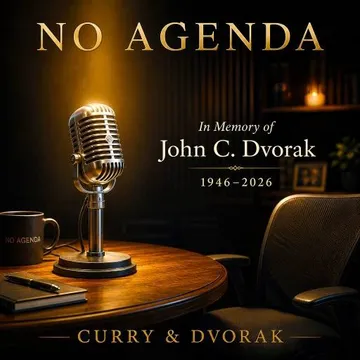
In The Mourning
Episode 1888 5:29:22 - 5:32:57

1888: In The Mourning

Computer Chronicles and Early Tech Media Influence

Donors recall first encountering John C. Dvorak on the PBS series Computer Chronicles in the 1980s and later on TechTV. One producer shares a story of being surprised by a personal email response from Dvorak, illustrating his accessibility to the audience. The segment features contributions from the Netherlands and various U.S. states, celebrating Dvorak's vast expertise and rich storytelling.

In The Mourning
Episode 1888 5:45:29 - 5:49:16

1888: In The Mourning

Proposal for a Dvorak Story Memoir and Archive Access

Producers suggest compiling Dvorak's various stories into a memoir and propose a special donation tier of $8,888.88 to release archives and office photos. Tributes continue to pour in from listeners who have followed Dvorak since his 1980s television appearances. The "reverb can" is cited as a unique and iconic element of Dvorak's contribution to podcasting history.

Buy the Crash
Episode 1882 45:55 - 51:17

1882: Buy the Crash

Nvidia Partnership, Palantir's Data Sovereignty Model

Palantir has entered a direct partnership with Nvidia to allow customers to run open large language models while maintaining control over their own data and "alpha." Alex Karp argued that enterprises want to own their means of production rather than transferring data to third-party providers. He also dismissed the "safety" marketing used by AI companies as a gimmick to avoid government oversight.

Buy the Crash
Episode 1882 1:13:54 - 1:16:30

1882: Buy the Crash

Data Privacy, Local Computing vs. Cloud Storage

The hosts advocate for local computing and the use of open-source operating systems like Linux to avoid data harvesting by large corporations. They criticize the public's willingness to upload personal data to the cloud while simultaneously fearing government surveillance. The discussion emphasizes that privacy is a choice made through hardware and software habits.

Antifa Book Club
Episode 1880 57:50 - 1:01:13

1880: Antifa Book Club

Quantum Innovation Executive Order, Cryptographic Security

President Trump signed two executive orders focused on the "Quantum Industrial Base" and post-quantum cryptographic security. The orders aim to accelerate American quantum leadership while preparing government systems for potential threats to current encryption standards. Skeptics view the emphasis on quantum technology as a potential "psyop" or a pivot from the current AI narrative.

Flim Flam
Episode 1877 1:57:20 - 2:00:49

1877: Flim Flam

Sovereign Capabilities, Quantum Computing, and NAFTA Renegotiation

Mark Carney emphasizes the need for Canada to build "sovereign capabilities" in energy and critical minerals through a trillion dollars in investment. He advocates for "ad hoc coalitions" rather than isolation, seeking to bridge the Trans-Pacific Partnership with the European Union. The discussion notes that these strategic shifts come as President Trump seeks to renegotiate major trade deals like NAFTA.

Lunar Economy
Episode 1872 1:24:57 - 1:28:22

1872: Lunar Economy

Helium-3 Extraction, Lunar Economy Skepticism

The "Book of Knowledge" defines Helium-3 as a potential fuel for future fusion reactors and a component in quantum computing. NASA officials suggest that extracting Helium-3 from the moon could spark a "lunar economy." The hosts remain doubtful, predicting that the Artemis missions will face significant delays or technical failures before achieving these goals.

Cone of Uncertainty
Episode 1861 1:49:17 - 1:58:41

1861: Cone of Uncertainty

Allbirds AI Pivot and the GPU-as-a-Service Bubble

Footwear company Allbirds has announced a pivot to become "New Bird AI," a GPU-as-a-service and AI-native cloud provider. This move is compared to the dot-com bubble, where companies added ".com" to their names to boost stock prices. The hosts discuss the broader "Neo Cloud" trend where companies rent out decentralized GPU power rather than building massive, expensive data centers.

Mork & Mimi
Episode 1851 2:07:45 - 2:10:01

1851: Mork & Mimi

IonQ and the Pivot to Quantum Computing

The CEO of IonQ discusses the company's partnership with the Department of War to integrate quantum programs into space, air, and undersea domains. The segment identifies a strategic pivot from AI to quantum computing as the next major technological wave in the race against adversaries like China. Critics argue that much of the current quantum rhetoric is "blather" similar to the overhyped promises of early AI.

Error Bars
Episode 1850 1:44:34 - 1:48:47

1850: Error Bars

Sam Altman on Economic Utility, AI Startups

OpenAI CEO Sam Altman claims the world has crossed a threshold into "major economic utility" for AI, particularly in coding and science. He observes a mental shift in startups that prioritize "compute" and "tokens" over hiring human employees to avoid slowing down their operations.

Podcaster Down!
Episode 1848 55:32 - 58:28

1848: Podcaster Down!

Apple Vision Pro, Spatial Computing for Podcasting

The Apple Vision Pro is analyzed as a business tool for "spatial computing" rather than just a consumer entertainment device. A vision for the future of podcasting is presented, where hosts use the headset to manage multiple virtual screens and "Minority Report" style interfaces while traveling.

A Dog A Day
Episode 1842 44:11 - 49:06

1842: A Dog A Day

Computer Science Enrollment Decline, Entry-Level Job Automation

The University of California system is reporting a significant drop in computer science enrollment, the first since the dot-com bust, as students fear entry-level roles are being replaced by AI bots. Experts suggest that while coding jobs are evolving, there is a growing need for "knowledge workers" who understand entire systems rather than just syntax. Vocational trades are highlighted as a stable alternative to automated white-collar work.

Moral Injury
Episode 1837 15:05 - 19:00

1837: Moral Injury

Linux Desktop Adoption, Windows Cloud Frustrations, Microsoft 365 Outage

Growing frustration with Windows 11 advertisements and forced cloud integration is reportedly driving a slow increase in Linux desktop adoption. Technical hurdles, such as configuring the Rodecaster audio interface on Linux, are being overcome by enthusiasts seeking more user control. Meanwhile, a major 36-hour Microsoft 365 outage recently disrupted corporate email for global entities like Marriott.

Spicy Mode
Episode 1833 1:37:08 - 1:40:21

1833: Spicy Mode

Gen Z Computer Illiteracy, Workplace Tech Skills

Middle management in tech companies reported a surprising lack of basic computer literacy among Gen Z employees, including those with IT degrees. Common issues cited include an inability to use the command line, lack of touch-typing skills, and unfamiliarity with basic troubleshooting like using the Task Manager.

Spicy Mode
Episode 1833 1:40:21 - 1:42:51

1833: Spicy Mode

AI Memory Shortage, RAM Price Surge

Prices for computer memory (RAM) are expected to rise by more than 50% this quarter due to unprecedented demand from AI companies. Major server farm providers and AI developers are buying up global supply, ending a period of historically low prices for consumer memory.

Lincoln's Dome
Episode 1832 2:40:01 - 2:46:09

1832: Lincoln's Dome

Education Crisis, Chromebooks and the Loss of Textbooks

Teachers are reporting a total absence of physical textbooks in many high schools, with students relying entirely on Chromebooks and digital PDFs. Critics argue that this shift has decimated attention spans, eliminated essential computer skills like typing and file management, and replaced active thinking with "digital babysitting." There is a growing call to return to computer labs and hands-on learning tools like paper and pencils.

No Agenda Christmas 2025
Episode 1828 1:37:00 - 1:38:47

1828: No Agenda Christmas 2025

Computer Chronicles, 1980s Tech Gift Ideas

An archival clip from the 1980s show *Computer Chronicles* features John C. Dvorak recommending Christmas gifts for tech enthusiasts. His suggestions include a cooling fan for the Macintosh called the "Fanny Mac" and a computer toolkit for straightening pins and pulling chips. The hosts laugh at the dated nature of the recommendations from 42 years ago.

Bible Belt Buckle
Episode 1818 51:37 - 59:09

1818: Bible Belt Buckle

Humain AI Startup, Omniverse Digital Twins, Quantum Simulation

NVIDIA announced a major partnership with the Saudi AI startup Humain to build massive data centers and develop "Omniverse Digital Twins." These digital twins are physically accurate virtual replicas of factories and environments where robots can train according to the laws of physics. Additionally, NVIDIA plans to use its hardware in Saudi Arabia to simulate quantum computers and perform complex error correction, despite skepticism regarding the feasibility of simulating unbuilt quantum systems.

Attunement
Episode 1815 2:03:45 - 2:06:07

1815: Attunement

Local AI Models and GPU Requirements

Running high-quality AI models locally requires significant hardware investment, with top-tier NVIDIA GPU stacks or Apple M4 Super Pro systems costing between $10,000 and $15,000. Local hosting is preferred by some for consistency, as cloud-based models can vary based on data center variables. The segment also touches on the financial stability of companies like OpenAI and the potential for government intervention in the AI race against China.

Needle Drop
Episode 1814 2:31:43 - 2:37:52

1814: Needle Drop

Sam Altman and the OpenAI Financial Bet

OpenAI CEO Sam Altman responds to concerns about the company's massive "compute" spending and potential for bankruptcy. Altman expresses confidence in steep revenue growth and hints at the development of "consumer devices." He dismisses critics on social media, suggesting they should "short the stock" if they believe the company is failing, while emphasizing OpenAI's goal to automate science.